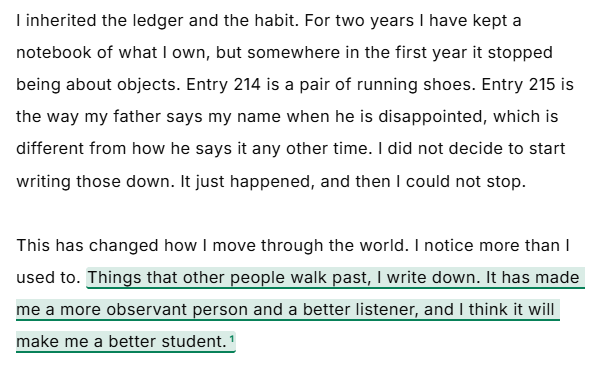
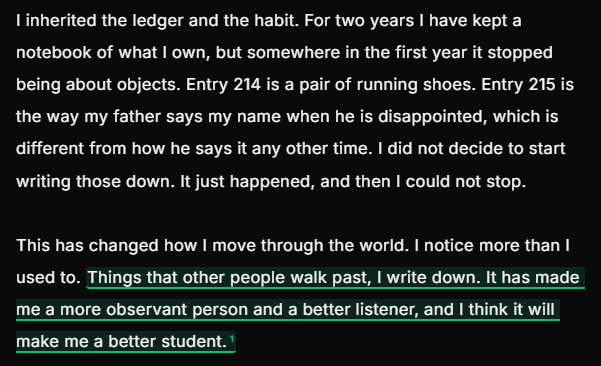
Your essay, graded by the rubric admissions officers actually use.
Paste your Common App essay. Get a score and feedback grounded in public guidance from MIT, Georgia Tech, and former Ivy League deans — not vague AI generalities.
Grade my essay freeFree. 1 grade per email every 30 days. No credit card.
From paste to revision, in three steps.
No upload, no formatting cleanup, no account. Paste your Common App essay, get a 25-point grade with per-trait reasoning, and revise with the specific anchors that scored you.
Watch it grade in real time.
Each block shows a piece of the actual EssayLab flow — the grading pipeline that scores your essay, and the revision view that shows you why.
See the rubricPaste, then watch it grade.
EssayLab reads your essay, matches against the 5-trait rubric, and scores each trait against published anchors. The whole pipeline finishes in about 30 seconds.
Revise with the reasoning.
Every trait score comes with a 2–3 sentence rationale tied to the rubric anchor it matched. You see which sentences earned the score — and which to rework before submitting.
A rubric you can actually point to.
EssayLab grades on a 5-trait, 25-point rubric. Every anchor cites public guidance from admissions officers — so you can see exactly what your score is graded against, not just what it says.
See an anchorPull anchors
Anchors cite real admissions officers.
Every trait score traces back to public writing from someone who reads applications for a living. No vibes, no AI generalities — sources you can look up yourself.
Three passes, twenty-five points.
Voice capture, rubric scoring, rationale drafting. Each pass runs against published anchors, then sums to your 25-point total with per-trait reasoning.
Every score traces to something real.
Not just a number — a rubric, a rationale, and a source for every trait. Built on what admissions officers have actually said, not on what AI assumes.
Built on what admissions officers said.
Not a synthesized 'best practices' list. Not vibes. Public writing from people who actually read applications, mapped to the schools you're applying to.
See the source listAnchored in admissions officers' own words.
MIT Admissions. Georgia Tech's Rick Clark. Former Penn dean Sara Harberson. Jeffrey Selingo's embedded reporting from Davidson, Emory, and UW. Public writing from people who read applications for a living — not a synthesized 'best practices' list.
Sources from the schools your readers come from.
Every rubric anchor traces to admissions writing from a specific institution. When MIT publishes how they read essays, that's an anchor. When Penn's former dean explains what they look for, that's an anchor. Your essay is graded by the schools' own words.
Pay once. Grade until it's ready.
No subscriptions, no auto-renew, no surprise charges. Pick what fits your application cycle.
Single
One full grade with reasoning.
- 1 full essay grade
- 5-trait score + 25-point total
- Per-trait rationale for every score
- Sourced rubric anchors
3-PackPopular
For the revise-and-resubmit cycle.
Everything in Single +
- 3 full essay grades
- Use across drafts or different prompts
- Per-trait rationale for every score
- Sourced rubric anchors
- Best value per grade
Unlimited
For supplementals, transfers, and heavy iteration.
Everything in 3-Pack +
- Unlimited grades for 30 days
- Across any number of essays or prompts
- Per-trait rationale for every score
- Sourced rubric anchors
- Ideal for full application season
What's included:
- 1 free essay grade per email every 30 days
- 25-point total score
- No per-trait breakdown (paid tiers only)
- No credit card required
Questions students actually ask.
If your question isn't here, email support@tryessaylab.com — we read every one.